
The word sustainability is everywhere today — in headlines, business plans, and global conversations. But what does it truly mean? At its core, sustainability is about balance — living in a way that meets our needs today without preventing future generations from meeting theirs.
This simple yet profound idea comes from the 1987 Brundtland Report, Our Common Future, which defined sustainable development as:
“Development that meets the needs of the present without compromising the ability of future generations to meet their own needs.”
Understanding Balance and Equilibrium
Sustainability is about finding equilibrium — a dynamic balance between what humanity takes from the Earth and what the planet can naturally replace. Every resource we use — water, trees, soil, or energy — has a replacement rate, or the speed at which it can renew itself.
When we live within that rate, systems stay stable. But when we take or consume faster than nature can restore, we lose balance. Forests vanish, fisheries collapse, and the climate shifts.
The Problem of Excessive Consumption
Modern life often runs on excessive consumption — using far more energy, water, and materials than the planet can sustainably provide. Our economies reward short-term growth, while ecosystems operate on long-term renewal. The result is overshoot: we’re living beyond the Earth’s means, borrowing from future generations to sustain today’s convenience.
Sustainability challenges us to see that every purchase, every policy, and every business decision is part of a larger pattern.
Systems Thinking: Seeing the Connections
Sustainability isn’t just about one issue — it’s about how everything is connected. This perspective is called systems thinking. It helps us understand that environmental, economic, and social systems don’t operate in isolation.
For example:
- Deforestation affects water cycles, which affects agriculture, which affects food prices and livelihoods.
- Pollution in one country can alter weather patterns and food supplies in another.
By seeing these feedback loops and interconnections, we begin to design solutions that address root causes, not just symptoms.
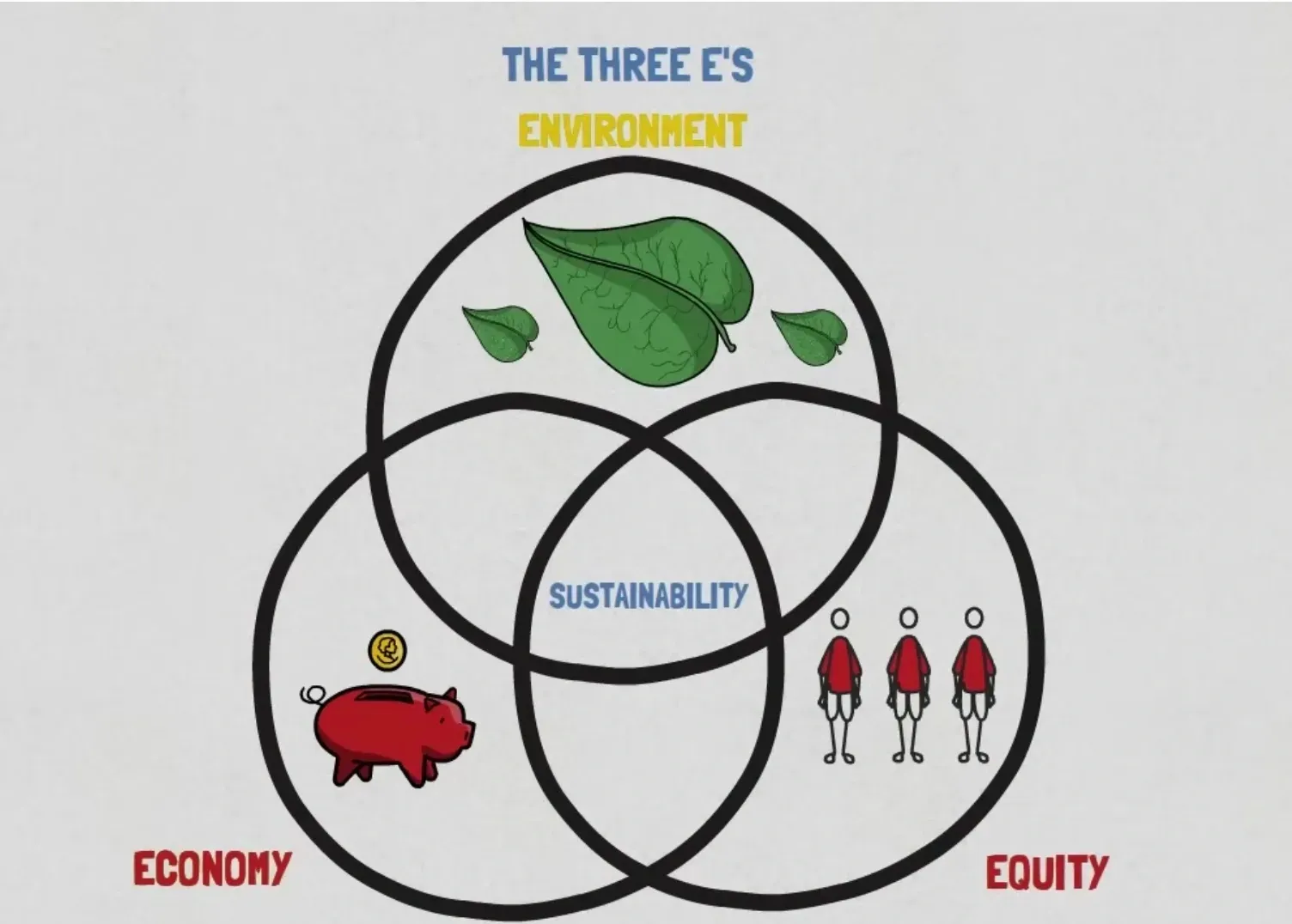
The Three E’s: Environment, Economy, and Equity
To live sustainably, we must balance what are often called the Three E’s:
- Environment – protecting the natural systems that make life possible.
- Economy – building a resilient and fair economy that operates within ecological limits.
- Equity – ensuring social fairness, opportunity, and inclusion for all people.
When these three elements are in equilibrium, society thrives. When one dominates — for example, economic growth at the expense of the environment or equity — the whole system begins to unravel.
The Path Forward
Sustainability isn’t about giving things up; it’s about reimagining progress. It means designing cities, businesses, and lifestyles that align with nature’s replacement rates and maintain global equilibrium.
It asks us to shift from excessive consumption to conscious regeneration — from seeing ourselves as separate from nature to recognizing that we are deeply embedded within it.
By applying systems thinking and honoring the Three E’s — Environment, Economy, and Equity — we can build a world that endures: one that prospers today and preserves the possibilities of tomorrow.
Author’s Note
Cezhan Ambrose, DBA (Pepperdine University), is a Postdoctoral Research Fellow and founder of EnviroGov Solutions. His work explores how governance, finance, and systems thinking can accelerate sustainability transformation.


