
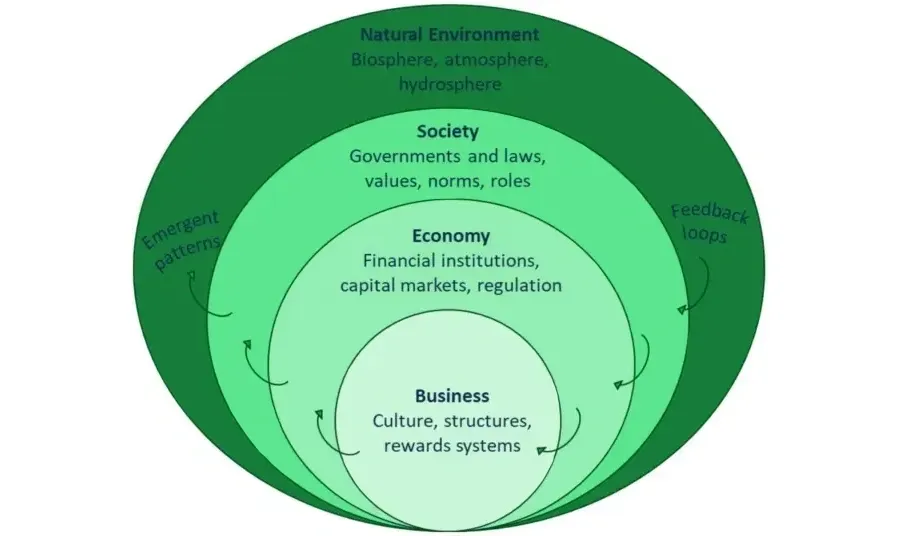
Climate change is often framed as a matter of carbon emissions and temperature rise. But if we zoom out—if we adopt a systems dynamics viewpoint—we see a far richer, more interconnected picture. In this blog post I’ll explore how the lens of system dynamics helps us understand the climate challenge: key feedback loops, stocks and flows, tipping points, and what this implies for governance, business, and strategy.
1. What is Systems Dynamics (and why it matters for climate)
Systems dynamics is a modelling and diagramming method that emphasises stocks, flows, feedback loops, delays, and non-linear relationships. climateinteractive.org+2System Dynamics Society+2
- A stock is an accumulation (for example: atmospheric CO₂, ice sheet volume, forest biomass).
- A flow is the rate of change into or out of a stock (for example: emissions, melting, regrowth).
- Feedback loops can be reinforcing (positive) or balancing (negative) and they often produce the dynamic complexity we observe in climate systems.
- Because of delays and non-linearities, system behaviour can be counter-intuitive.
In short, applying systems dynamics to climate enables us to move beyond simple “cause → effect” narratives, and to capture how human, ecological, geophysical and economic systems interlock. For example: a change in human behaviour → emissions → atmospheric concentration → temperature → ice melt → albedo change → further temperature rise.
According to Climate Interactive, their simulators (such as En-ROADS and C-ROADS) are built on exactly this systems-dynamics logic: understanding how different policies ripple through the interconnected system. globalsociety.earth+1
2. Key feedback loops in the climate system
From a systems dynamics perspective, one of the most powerful insights comes from the loops — how a change in one part of the system circles back to reinforce or dampen that change elsewhere.
a) Reinforcing (positive) feedbacks
- Ice–albedo feedback: As ice melts, dark water or land is exposed, absorbing more solar radiation, warming further, causing more ice melt.
- Permafrost carbon feedback: Warming → thawing permafrost → release of CO₂ and methane → more warming. (See tipping points section below)
- Forest die-back / carbon sink loss: Forests that absorb CO₂ are stressed by heat, drought, pests → they absorb less (or even release) CO₂ → atmospheric concentration rises → warming accelerates.
b) Balancing (negative) feedbacks
- Some natural sinks (oceans, forests) absorb carbon, which helps dampen the rate of concentration rise. But their capacity is limited and non-linear.
- Technological and policy feedbacks: e.g., higher carbon prices → behaviour change → lower emissions (if implemented in time).
c) Stocks, Flows & Delays
- Stock: Atmospheric CO₂ concentration — built up over decades from flows of emissions minus sinks.
- Delay: The warming effect of CO₂ does not appear instantly; the climate system (oceans, ice, land) has inertia.
- Stock: Ice sheet volume. Flow: melt + calving. Once a certain threshold is crossed, the melt flow may dominate and the ice sheet may shrink rapidly.
In modelling climate change, system-dynamics models integrate biophysical and socio-economic variables into unified frameworks. For example: “Integrated simulation models are useful tools to understand complex socio-ecosystems.” PubMed+1
3. Tipping points and regime shifts
A crucial system-dynamics insight is that some parts of the climate system are non-linear and may undergo irreversible or difficult-to-reverse shifts once a threshold is crossed. These are often called tipping points. Wikipedia+1
Examples:
- The collapse of an ice sheet (Greenland Ice Sheet or West Antarctic Ice Sheet) which once triggered may continue for centuries.
- The shift of the Atlantic Meridional Overturning Circulation (AMOC) to a weaker state, altering ocean heat transport and regional climate.
- The die-back of the Amazon Rainforest into savannah, undermining a major carbon sink.
In system‐dynamics terms: a reinforcing loop becomes dominant and the system moves to a new equilibrium (regime). Once that new regime is reached, returning to the old one may be extremely difficult, requiring a large “push”.
4. How human systems enter the loop
It’s not just natural systems. Human economic and governance systems are part of the feedback structure: emissions, energy systems, land use, policy, innovation—all flow into the climate system and are subject to dynamic responses from it.
From a governance / business perspective:
- Investments in fossil infrastructure lock in flows of emissions (stock built up).
- Policy delays (e.g., slow carbon pricing) create large stocks of carbon that will remain for decades.
- Technological innovation can alter flows more quickly (for example, renewables, storage, behavioural change).
- Adaptation and resilience investments can reduce vulnerability to system shifts, but if tipping points are reached, the human cost may accelerate.
Understanding climate change thus means understanding the coupled human-natural system, not simply “carbon emitted = temperature up”.
5. Implications for strategy, governance and business
Since you’re working in ESG / stewardship (and your research is grounded in systems thinking and sustainability), this systems dynamics framing offers several strategic insights:
- Take stock seriously: Atmospheric CO₂, planted forests, soil carbon—all are stocks. You can’t just focus on flows (annual emissions), you must consider the accumulated legacy.
- Act early: Because of delays and inertia, waiting until effects are observable means you’ve already locked in undesirable trajectories.
- Beware lock-in and feedback loops: Investment decisions today create inertia. For example, building new fossil plants creates long-lived assets and high emission flows unless mitigated.
- Prepare for non-linear change: Many sustainability risks are not gradual but may accelerate via feedback. Governance mechanisms must be designed for resilience and flexibility.
- Link governance to system feedbacks: Mechanisms that promote transparency, accountability, board independence and compensation aligned with ESG (your hypotheses) help ensure organisations recognise and respond to system dynamics rather than treating them as linear “business as usual” risks.
- Scenario planning is essential: Because system behaviour is non-linear, scenario modelling (e.g., via tools such as En-ROADS) gives a fuller picture than point forecasts.
- Collaborative systems change: Because climate is a global common-pool system with many actors, governance must engage multi-stakeholder, cross-sector dynamics—not siloed business strategies.
6. A simple systems dynamics sketch: Carbon → Climate → Impact loop
Here’s a simplified conceptual mapping:
- Stock: Atmospheric CO₂
- Incoming flow: Fossil-fuel & land-use emissions
- Outgoing flow: Natural absorption (oceans, forests) + engineered removal (CCS, afforestation)
- Stock: Global mean surface temperature / heat in system (including ocean heat)
- Flow: Energy imbalance (more incoming solar energy than outgoing infrared) influenced by greenhouse gases, aerosols, albedo
- Feedbacks: Warming → ice melt → albedo reduction → more absorption → further warming. Warming → permafrost thaw → methane/CO₂ release → more warming.
- Human system: Governance, investment, innovation influence emissions flow; adaptation/investment flows influence vulnerability to climate impacts (heat waves, floods, droughts)
- Tipping point risk: If a reinforcing feedback overtakes the balancing feedbacks, the system may shift to a less desirable regime (higher temperature, higher sea level, different circulation).
7. Closing thoughts
Adopting a systems-dynamics mindset does not make the challenge of climate change simpler—but it does make it truer to reality. It forces us to recognise:
- Interconnections matter
- Delays, inertia and non-linearity matter
- Stocks built up over decades matter
- Feedback loops matter
- Governance, economics and ecology are intertwined
For those of us in governance and sustainability, this means we must design interventions that are not just incremental but systemic. That recognise that organisational governance is one piece of a much larger system. That focus on resilience, adaptation, and transformation—not simply risk mitigation.


